

• News
  • Add Your Events
  • Support & Advertise
  • Contact Us

Logo

Navigation
  • Art News
  • Art Listings
    • Current Exhibitions
    • Upcoming Exhibitions
    • Auctions
    • Workshops
    • Talks
    • Guided Tours
    • Festivals, Markets, Parties
    • Kids’ & Families’ Events
    • Performances
    • Film
    • Open Calls
  • Art Venues

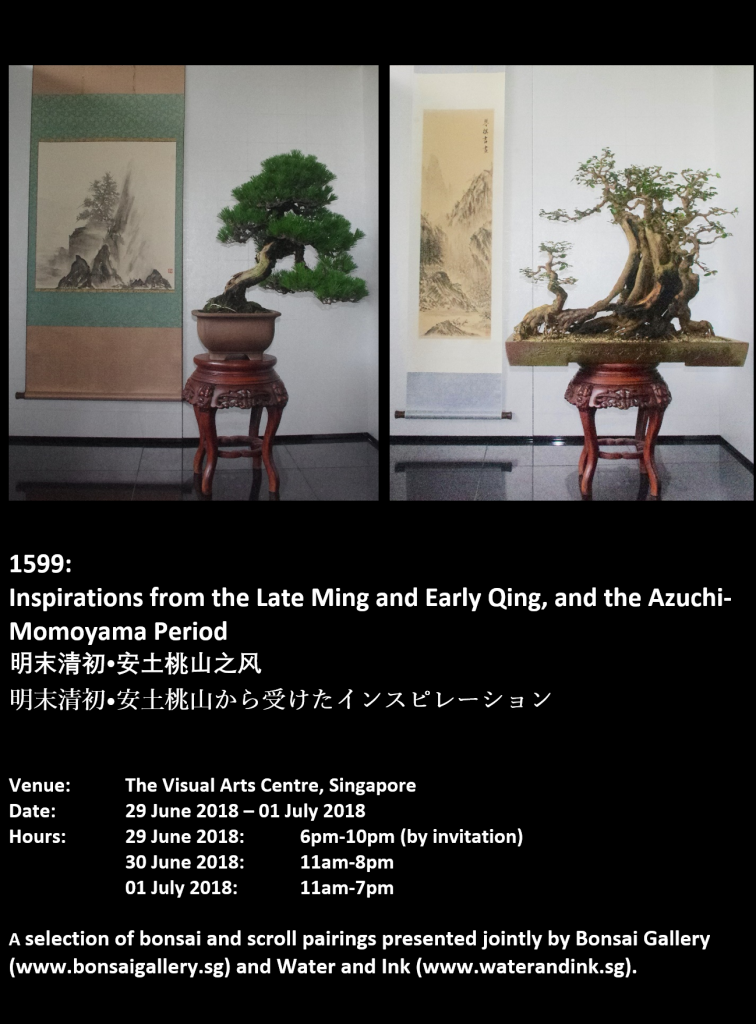
1599 Inspirations from the Late Ming and Early Qing, and the Azuchi-Momoyama Period

“The bonsai never sees the sun, but of itself it remains a deep green.”


1599, Inspirations from the Late Ming and the Early Qing, and the Azuchi-Momoyama Periods 明末清初 • 安土桃山时代之风

The setting

The latter part of the 16th Century and the first few decades of the 17th Century were a tumultuous time in East Asia.

In China, this coincided with the decline and end of the Ming Dynasty (明朝) and the rise of the Manchurian Qing (清朝), whilst in Japan, the Ashikaga military government (足利幕府) was finally abolished, and the Tokugawa regime (德川幕府) established, bringing to an end a century and a half of civil war.

So the Ming gave way to the Qing, and the Ashikaga to the Tokugawa, but in each case, decades long periods of transition, which have become known as eras in their own right; Mingmo-Qingchu (明末清初, the End of the Ming and the Beginnings of the Qing), and the Azuchi-Momoyama (安土桃山) respectively.

As may be expected, the exact dating of each is the subject of much historical debate; transitions are messy. What may be said of each with some confidence is that, in 1551, the period was still some way in the future, and that by 1650, it had long since ended.

We chose the year 1599 therefore as a proxy for a year which could reasonably be argued to have fallen within both these periods. Or maybe just before. Or maybe just after.

Of course, 1599 would quite clearly have been approaching the end of a century by the Gregorian reckoning, but bear in mind that this was not the convention in use in both of those countries at the time; aside from the cyclical lunar calendar, it was the 27th year of the Wanli Era (万历二十七年) in China and the fourth year of the Keicho (庆长四年) Era in Japan.

What would have been clear in both cases however was that an old older was ending, and a new one beginning. What could not have been foreseen at the time though, was that this was the last time that a Chinese Dynasty would be supplanted by another, and a new Japanese “tent government” (幕府, an old literary synonym for “military government”) appointed to replace the previous incumbent; both the Qing and the Tokugawa themselves would ultimately be swept away in a collision with the modern world.

Art, exhibition and aftermath

Needless to say, transitions are inherently paradoxical: beginnings and ends. Extending this just a little further, what use aesthetics when basic human needs such as food, shelter and safety become uncertain?

We can’t answer that. What will be observed though is that, time and time again, art does continue to be produced during such periods, and that often, that very uneasiness gets channeled into a kind of vibrant urgency with powerful results. It’s precisely when life becomes diminished that the human spirit affirms itself most forcefully.

In this exhibition, you won’t just be looking at plants paired with scrolls. Every detail, including the choice of pot and table, the style of mounting, and the relative positioning, has been carefully selected. Appreciate the details, it would be a shame to miss half the fun.

The aim has also not been to recreate an object or arrangement exactly in the manner of a museum-reproduction; even a precise replica of something is not quite the same by virtue of the fact that it was produced under different circumstances. Rather, we have respectfully inquired into the spirit of that age, and it has informed the present display.

“Revise the old and know the new (温故知新)…”

There have been many 1599s. It’s only with hindsight that latter generations can say definitively, “that was a turning point”. And you never quite know at the time that you were living in 1599, and all the things it would come to mean. But maybe even then it’s perceptible, being alive at the turn of an era, which is in itself an event, which is in the end a flicker in time; an accretion of sights and sounds, happenings large and small, a tingle in the air…

It’s almost inconceivable when you try to place yourself in that situation; pruning with exactness a small, ornamental tree, painting and deciding on a complementary poem or aphorism. Perhaps the message, timeless and un-eroding, to take away is this:

You are alive today, here and now, by choice or otherwise. But do your best, whatever that may mean to you. It may have far-reaching consequences, good ones, maybe even beautiful, that you could never have anticipated.

Venue: Visual Arts Centre


When: 29 Jun - 1 Jul 2018,

By: Visual Arts Centre Exhibition Gallery

Share this story:
  • tweet

Comments are closed.

Art Calendar

SAGG on Facebook

Singapore Art & Gallery Guide

10 hours 8 minutes ago

www.channelnewsasia.com/singapore/gillman-barracks-hdb-tenants-arts-housing-6250661

Gillman Barracks tenants disappointed as site set to make way for housing after 2030

The tenancies of businesses at Gillman Barracks will expire progressively by the second quarter of 2030 to make way for housing.

View on Facebook
Share

Singapore Art & Gallery Guide

1 week 5 days ago

www.straitstimes.com/life/arts/artist-chua-mia-tee-singaporean-master-of-social-realism-dies-at-94 #ChuaMiaTee

Chua Mia Tee: Singaporean social realism master dies at 94

Remembering Chua Mia Tee, the Singaporean master of social realism, celebrated for his iconic oil paintings, who has died at the age of 94. Read more at straitstimes.com. Read more at straitstimes.com.

1
View on Facebook
Share

Singapore Art & Gallery Guide

1 week 6 days ago

www.straitstimes.com/life/arts/non-profit-launches-10m-accelerator-programme-for-early-career-spore-artists-with-2000-stipend

Singapore artist accelerator programme launched

A new non-profit launches a $10m accelerator programme providing stipends and support for early career Singapore artists. Read more at straitstimes.com. Read more at straitstimes.com.

2
View on Facebook
Share

Singapore Art & Gallery Guide

2 weeks 5 days ago

www.straitstimes.com/singapore/rest-easy-uncle-pek-kio-twig-artist-y-l-thien-dies-at-83

Singapore twig artist Uncle Thien dies at 83

Remembering Y.L. Thien, the beloved Pek Kio twig artist known for his unique ground art, who passed away at the age of 83. Read more at straitstimes.com. Read more at straitstimes.com.

2
View on Facebook
Share

Singapore Art & Gallery Guide

4 weeks 2 days ago

www.channelnewsasia.com/today/big-read/singapore-street-art-regulations-vibrancy-public-attitudes-6193461

Street art is flourishing in Singapore. So why does it still make some people uneasy?

As murals, busking and other forms of street art become increasingly common in Singapore's public spaces, artists say acceptance has grown to some degree. Yet, they can't shake off the sense that such art remains carefully curated and managed.

1
View on Facebook
Share

Singapore Art & Gallery Guide

1 month 1 week ago

www.straitstimes.com/singapore/cj-hendrys-flower-market-extended-until-june-15-due-to-overwhelming-demand

Cj Hendry’s Flower Market extended till June 15 due to ‘overwhelming demand’

Additional registration slots are now available. Read more at straitstimes.com. Read more at straitstimes.com.

View on Facebook
Share

Singapore Art & Gallery Guide

1 month 1 week ago

www.8days.sg/entertainment/local/fake-plush-flowers-rush-gardens-bay-859101

Why Were People Rushing To Grab Fake Flowers At This Exhibition At Gardens By The Bay?

Visitors were seen scooping up armfuls of plush flowers at Cj Hendry's viral Flower Market exhibition, sparking debate online.

View on Facebook
Share

Singapore Art & Gallery Guide

1 month 1 week ago

www.straitstimes.com/life/arts/gallerist-valentine-willie-pioneer-at-tanjong-pagar-distripark-dies-at-71

Gallerist Valentine Willie, pioneer at Tanjong Pagar Distripark, dies at 71

The lawyer-turned-curator modernised advanced South-East Asian art on the regional stage. Read more at straitstimes.com. Read more at straitstimes.com.

View on Facebook
Share

Singapore Art & Gallery Guide

1 month 2 weeks ago

pluralartmag.com/perhaps-we-must-pause-in-order-to-go-on-inside-the-singapore-pavilion-at-the-2026-venice-biennale/

Perhaps We Must Pause, in Order to Go On: The Singapore Pavilion at the 2026 Venice Biennale

Venice sits on an upside-down forest. Beneath the stone are millions of trees driven into the sedimentary clay below the waters, their tips pointed downwards. Larch, pine, oak, elm, alder, […]

View on Facebook
Share

Singapore Art & Gallery Guide

1 month 3 weeks ago

www.thinkchina.sg/culture/ai-weiwei-figure-past

Is Ai Weiwei a figure of the past?

By embodying recognisable themes of political dissent, ideological trauma and cultural memory, early Chinese contemporary artists like Ai Weiwei acted as interfaces that helped the West understand China. But the milieu has changed, requiring new-gen artists to reexamine their identity and their art....

View on Facebook
Share
  • News
  • Add Your Events
  • Support & Advertise
  • Contact Us
  • Privacy Policy & Terms
© 2020. Singapore Art & Gallery Guide
We use cookies that are necessary for the website's functions. If you continue to use this site we will assume that you are happy with it.